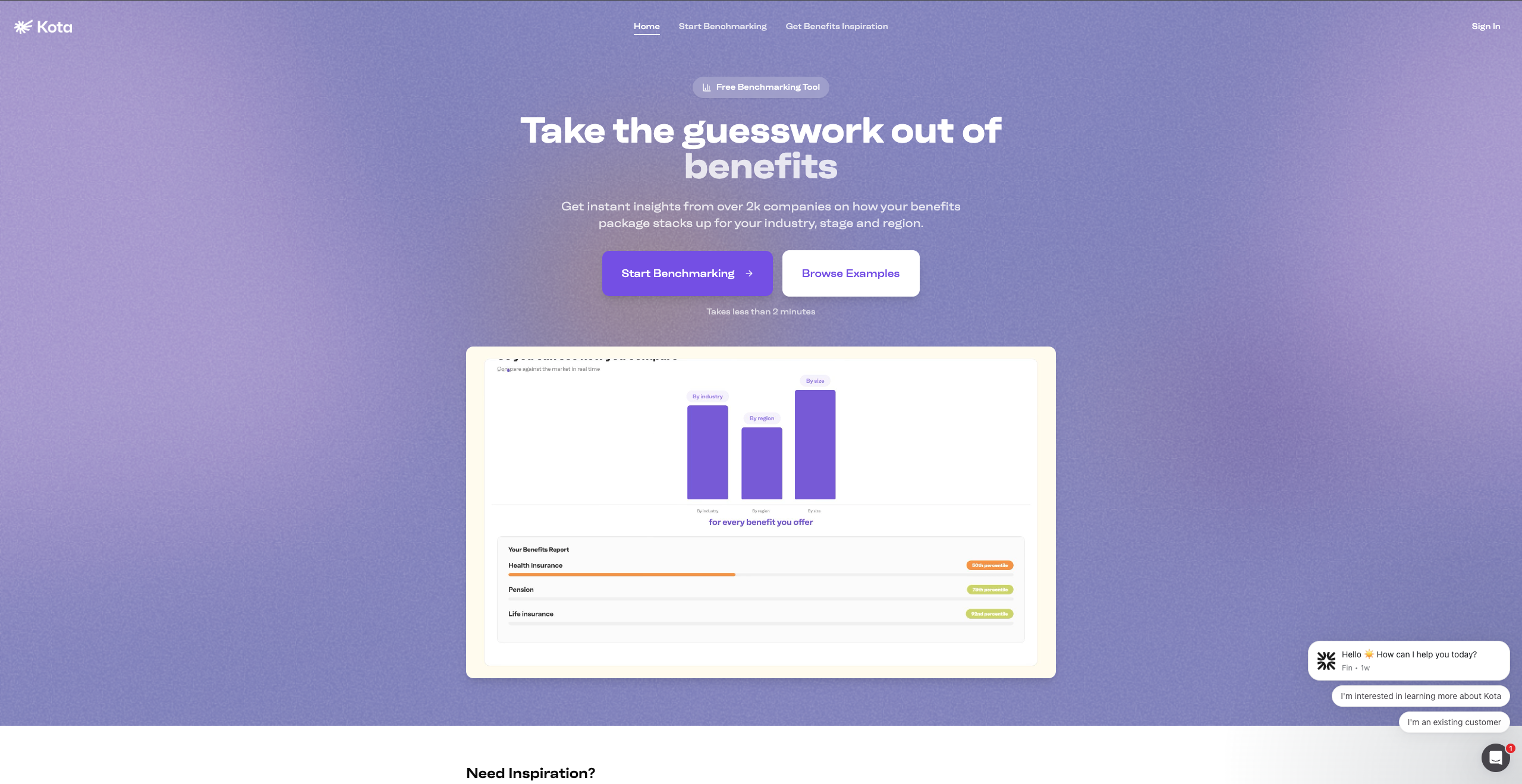
Today, Kota launches a free employee benefits benchmarking tool - so HR and People teams across the UK and Ireland can finally see how their package stacks up against 1,830 companies, by industry, region, and company size, in two minutes.

.png)
.png)
.png)
Too often, People teams are forced to make crucial decisions about employee benefits completely blind.
Your broker sends a quote. You compare it to last year. You sign it. You never really know if you got a good deal - whether you're ahead of the market or haemorrhaging talent to competitors offering twice what you are. And that's not on you. Until now, there's been no easy way to find out.
Today, we're changing that. Kota has launched a free employee benefits benchmarking tool - so HR and People teams across the UK and Ireland can finally see exactly how their benefits package compares to peers, by industry, region, and company size.
Employee benefits benchmarking is the process of comparing your company's benefits package - health insurance, pension contributions, life cover, income protection, flexible benefits, and more - against what other companies in your industry, region, or size bracket are offering.
Done well, it helps answer the questions HR leaders actually need answered:
Traditionally, this kind of data has been locked inside broker reports, surveys, and consultant-led benchmarking exercises that cost thousands and take months to complete. The Kota Benefits Benchmark makes it free and instant.
The stakes for getting this wrong have never been higher.
41% of UK employees cite a competitive benefits package as a top priority when choosing a new employer (Drewberry, 2024). And 32% of HR leaders report that benefits are their single biggest challenge when attracting new hires (Ravio, 2025).
Yet most companies are still making benefits decisions with almost no market data. The result is predictable: packages that feel generous internally but are quietly uncompetitive externally, and People teams who can't make the case for change because they don't have the numbers to back it up.
In Ireland specifically, 2026 brings additional urgency. The rollout of mandatory pension auto-enrolment means employers need to audit their entire benefits stack - not just to comply, but to understand how their overall package holds up once every company in the market is offering a baseline pension.
In 2026, benchmarking both internally and externally is the foundation of a winning people strategy.
Effective employee benefits benchmarking involves three steps.
Generic market averages are rarely useful. What matters is how you compare to companies of a similar size, in your sector, in your geography. A 50-person fintech in Dublin should be benchmarking against other fintechs - not the FTSE 100. A 200-person professional services firm in Manchester has a completely different competitive set to a remote-first SaaS company of the same size.
The reason this matters: talent doesn't move across industries as often as it moves within them. Your candidates are comparing you to your direct competitors, not to some theoretical market average. Your benchmark should reflect that.
This is where most benchmarking data falls short. It tells you which benefits companies provide - health insurance, pension, life cover - but stops there. The more important data point is what they actually contribute towards each one.
Offering private health insurance and contributing €50/month towards it are very different propositions. A company that contributes €300/month is offering something genuinely valuable. A company contributing €50 is largely offering the admin of having a policy. Candidates and employees know the difference, even if the benefits list looks the same on paper.
Benchmark at the contribution level, not just the benefit level. It's the only way to understand what you're actually competing against.
Not every gap is equally important, and trying to fix everything at once is a reliable way to fix nothing. Focus first on the benefits that matter most to your target talent pool - typically health insurance coverage and employer contribution rates, pension contributions, and flexibility around working arrangements - before turning your attention to secondary perks.
The question to ask is: which gap, if closed, would have the most impact on our ability to hire and retain the people we actually want? Start there.
This is exactly what the Kota Benefits Benchmark is built to help you do.
We've built a free benchmarking tool for HR and People teams - so you can see exactly how your benefits package stacks up against 1,830 companies across the UK and Ireland.
By industry. By region. By company size. In two minutes. For free.
No broker involved. No sales call required. Just data, and a clear picture of where you stand.
A benchmarking tool is only as good as the data behind it.
Ours is built from two sources. The first is a database of over 1,830 company benefits packages, collected from public-facing career pages and job listings across the UK and Ireland - the largest database of its kind. The second is Kota's anonymised customer data, which gives us something most benchmarking tools don't have: real contribution amounts, not just a list of benefits offered.
Most employee benefits benchmarking data tells you that a company offers health insurance. Ours tells you how much they're contributing towards it.
You can filter by industry, company stage, and region - so you're always comparing yourself to the right peer group, not a generic market average.
Complete a benchmark in under two minutes and you'll see:
We're not going to charge for benchmarking data. The industry has kept this information unnecessarily expensive and inaccessible for too long - and that's a core part of why employee benefits have stayed stuck in the past.
If the benchmark shows you gaps and you want to fix them, Kota can help with that too. But that's entirely up to you.
See how your benefits package stacks up → benchmark.kota.io
It takes two minutes. You don't need to book a call. And you might be surprised by what you find.
CEO and co-founder at Kota - building the future of employee benefits.

.png)
.png)
.svg)
.svg)
.svg)