HR tech has pulled every workflow on-platform - except benefits, which still live in brokers' inboxes and spreadsheets. With public healthcare under pressure and benefits now a core hiring lever, a new infrastructure layer is making embedded, global benefits finally possible.

.png)
.png)
.png)
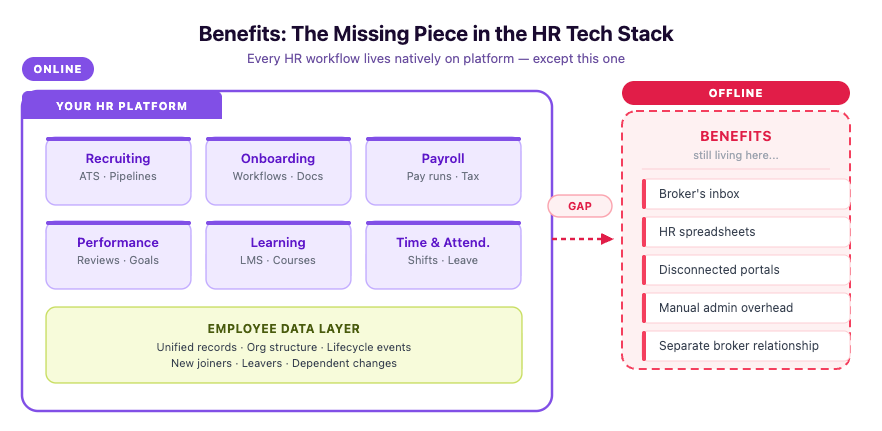
HR tech has spent the better part of a decade consolidating everything. Recruiting, onboarding, performance management, payroll, learning - all pulled under one roof. Vendors competed on breadth. Customers rewarded with interoperability and a more streamlined procurement process. The logic was simple: every workflow that lives natively on your platform is one less reason for a customer to leave.
And yet health insurance and benefits still largely exist somewhere else. In a broker's inbox. In a PDF. Hidden behind a portal that treats good UX as optional. In a spreadsheet maintained by an HR manager who has better things to do.
For years, private health coverage sat in the 'nice to have' column. A perk for senior hires. A differentiator for larger employers. That era is over.
Employer-funded health coverage is now a minimum standard for acquiring and retaining top talent - and the data is unambiguous. Research from Employment Hero shows that 53% of UK workers say better benefits would factor into changing jobs, making it the third most common reason people move roles. There's a name for it now: 'benefitsmaxxing' - employees systematically evaluating the total value of their package, not just headline salary.
"Benefits have become one of the most practical levers employers have to attract and retain people - and employees know it." - Employment Hero, 2026
But offering benefits comes with a problem. Because benefits sit outside the HR platform, every new joiner, leaver, and dependent change requires someone to manually notify the insurer, chase a broker, or update a spreadsheet. The operational overhead is significant - and it falls entirely on HR teams who are already stretched.
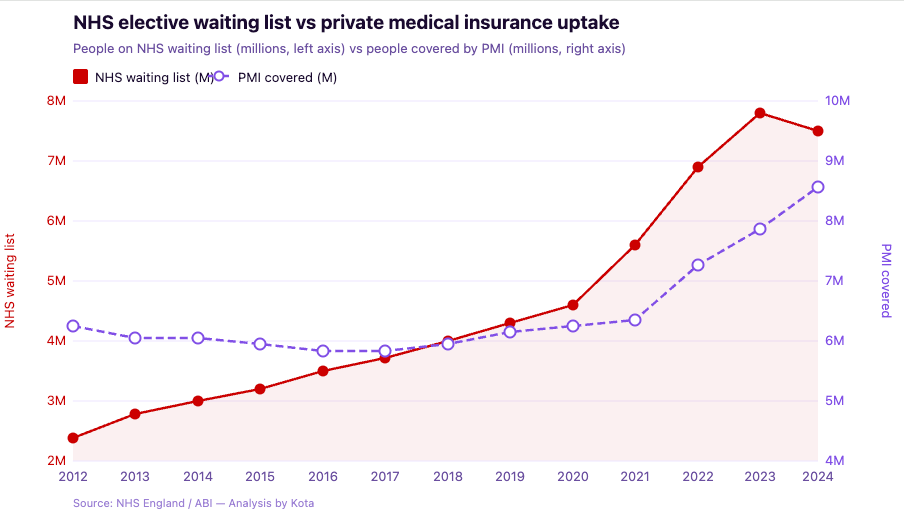
With public systems under sustained pressure across Europe and the western world, the demand for employer-sponsored private coverage is growing whether businesses are ready to administer it or not. The question is no longer whether to offer benefits - it's how to do so without it becoming a full-time operational burden.
This isn't a new problem - it's a solved one, in a market most HR tech leaders know well.
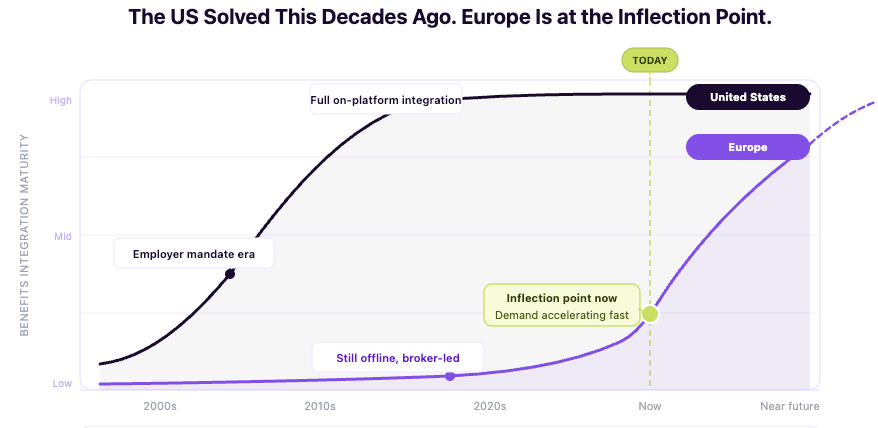
In the United States, employer-sponsored health insurance has never been a perk. It's been the baseline. A fundamental condition of employment, woven into the social contract for decades. Because the stakes of not offering coverage are so high, the market had no choice but to build the infrastructure to match. Benefits didn't end up inside US HR platforms because vendors were visionary - they got there because managing it any other way became operationally impossible at scale.
Having spent the better part of a decade working in North America, I saw this firsthand. Employers competing on plan design. HR teams benchmarking compensation using benefits data. Candidates negotiating coverage alongside salary. The idea of running any of that through a broker's inbox would be unthinkable - not because US companies are more organised, but because the infrastructure to do it properly has existed for so long that nobody remembers the alternative.
Europe is now approaching the same inflection point. When I returned home a few years ago, the contrast was stark - benefits were still largely discretionary, broker-led, offline, and disconnected from the systems managing everything else. That's changing fast, driven by two forces: public healthcare systems under structural pressure that are pushing employers to fill the gap, and governments across European markets actively incentivising employer-sponsored provision through tax treatment and regulatory reform.
The rest of the world stayed offline for one reason: complexity. Every country has its own regulatory requirements, compliance rules, insurer relationships, and tax treatment. For most HR tech providers, the ROI case for solving benefits market by market - outside the US - simply didn't stack up. So they didn't start. The result: global HR platforms with fundamentally local benefits capabilities, and every non-US employee still operating the way the US did twenty years ago.
That’s now changing.
The barrier was never demand. It was the absence of infrastructure - a layer that handles regulatory compliance, insurer relationships, and local plan administration across markets simultaneously, in a form that HR platforms can actually build on.
Kota has built that layer. Regulatory compliance, local market connectivity, and insurer relationships are embedded into the platform - not bolted on market by market. For an HR or payroll provider, this removes the obstacle that made global benefits expansion historically unworkable. You no longer need to build the compliance infrastructure yourself.
The proof is in the market. In February 2026, Employment Hero - serving over 350,000 businesses globally - launched health insurance directly within its platform, through Kota. For thousands of UK SMEs already running HR and payroll through Employment Hero, health cover is now available without leaving the platform, without manual spreadsheets, and without a separate broker relationship.
That is what embedded benefits look like. And it is happening now - not in a roadmap, but live, at scale, in markets that previously had no accessible path to this.
The direction of travel for HR and payroll platforms is clear: benefits are moving online - and becoming central to the HR stack. Bringing benefits on-platform reshapes the competitive dynamic in three key ways:
The platforms that win the next phase of consolidation will be those that own the most complete picture of the employee life cycle and benefits, (especially health insurance) sits at the centre of that.
Until recently, this shift was constrained by infrastructure. Outside the US, regulatory complexity, fragmented insurer networks, and manual broker-led processes made global benefits integration difficult to scale.
That constraint is now being removed.
A new infrastructure layer is emerging - one that embeds compliance, connects local markets, and makes global benefits a scalable, self-serve product. For the first time, HR platforms can integrate once and offer benefits globally.
This is the inflection point.
What has historically lived offline is moving online - into the platforms where it always belonged. And it’s happening globally, not just in the US.
The shift is already underway. The only question is who leads - and who follows.
Leading Kota Embed's go-to-market strategy to make global benefits accessible beyond the US by embedding our infrastructure into leading HR platforms.

.png)
.png)
.svg)
.svg)
.svg)