

Set up health cash plans without the benefits admin
Your people are already spending money on dental check-ups, eye tests, and physio appointments. A corporate health cash plan pays them back, turning everyday healthcare costs into an employer-sponsored value they'll see and feel regularly, not just when they’re ill. Kota is the broker and platform that helps you find the right plan, enrol your people, and manage it all in one place.
.avif)















About
health cash plans
What is a health cash plan?
It’s cost-accessible for you as the plan sponsor. You pay a flat monthly premium per employee. No age-weighted pricing surprises and no complex underwriting. Many small and scaling teams use a health cash plan as a standalone benefit; others offer it alongside existing cover. Either way, costs stay predictable and easy to plan for.
Cover generally includes:
-> Dental treatment and check-ups
-> Optical care, including eye tests and glasses
-> Physiotherapy and complementary therapies
-> Prescriptions and specialist consultations
-> Mental health support and counselling
Health cash plans vs.
Private medical insurance
A health cash plan works at the other end of the spectrum. It covers the routine, everyday healthcare costs your people are already dealing with, which is why cash plans see consistently high engagement from employees.
Why offer health cash plans?

Your people see and feel the value
A health cash plan means:
- Your people frequently engaging with a benefit you're funding
- Your people actually using a benefit they remember, which reflects well on your business
- Your people feeling supported for costs they genuinely care about
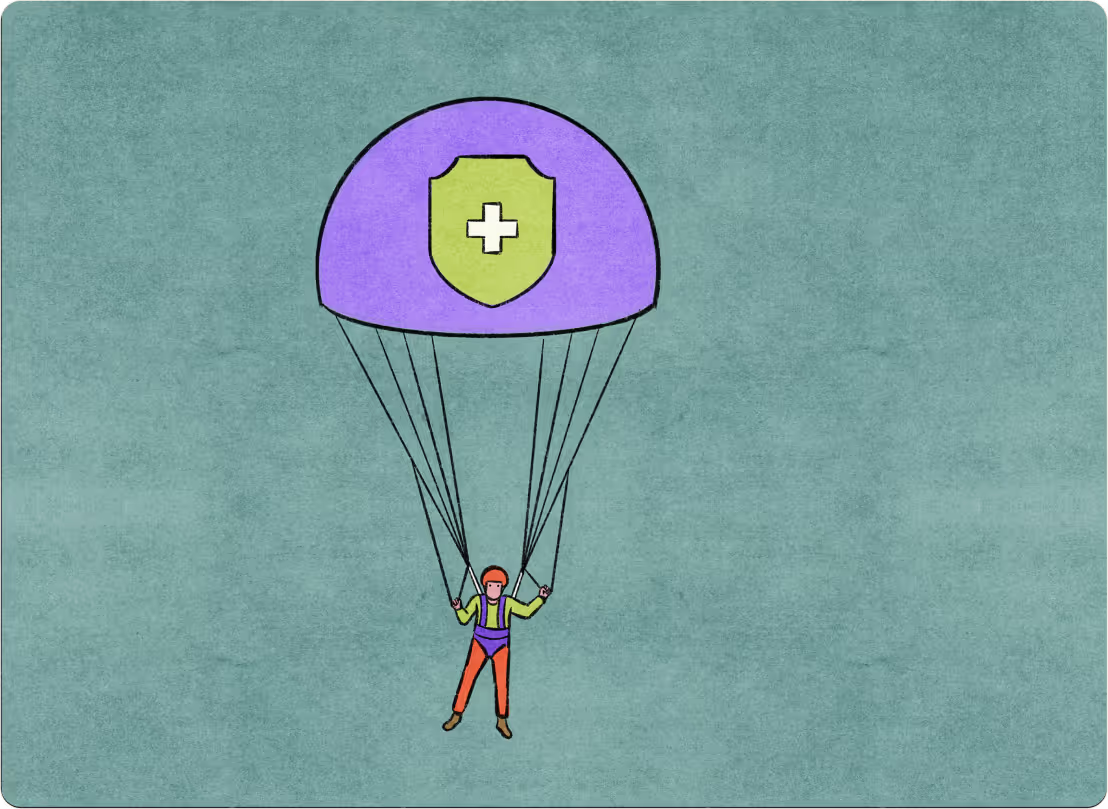
Strengthens your recruitment and retention
With a health cash plan, you:
- Give candidates a concrete, everyday benefit to factor into their decision
- Help your people feel valued through consistent, practical support beyond cover for big life events
- Strengthen your employer brand by showing you invest in your people's wellbeing year-round

Affordable without renewal shocks
In practice, that means:
- No age-weighted pricing surprises since this benefit uses a flat monthly premiums per employee
- Costs scale cleanly as your team grows
- What you agree is what you pay month after month, which removes any last-minute renewal panic

Supports your employees'
financial wellbeing
An employer health cash plan:
- Reimburses the everyday healthcare costs your people might otherwise go without
- Reduces the financial stress that quietly affects focus, morale, and productivity
- Shows your people you understand the real pressures they're facing
How to set up your
health cash plan
Here's what that process looks like end to end.
Assess your needs and
compare providers
Before committing to a plan, you need a clear picture of what your workforce needs. Consider your team's age profile, existing benefits that might overlap, and which healthcare costs they’re most likely to claim for. From there, compare providers - cover levels, claim limits, included services, and pricing tend to vary.
Select plan level and terms
Your cover level determines how much cashback your people can claim across categories. Then your eligibility rules determine whether cover kicks in from day one or after a probation. It's also worth considering whether you want a single plan for all employees or different levels based on seniority or role.
Provide group data
Your provider will need basic data about your workforce to go live. This usually includes employee names, dates of birth, job titles. Errors at this stage can create coverage issues and payroll headaches down the line. If your employee data lives across multiple systems, this is where the admin can start to feel heavy.
Finalise and enrol your people
Once your provider has your group data and your plan terms are agreed, employees are enrolled onto the scheme. They receive a welcome communication from the insurer outlining their cover, how to submit claims, and what they're entitled to. This process can take up to two weeks.
Go live and manage ongoing admin
The real admin begins when your plan goes live. Every time someone joins or leaves your team, their details need to be updated with the provider. Cover changes, eligibility updates, and payroll adjustments all require accurate, timely data flowing between your HRIS, your provider, and your payroll system.
Unsure where to start? Get a free benefits review.
.svg)
.svg)
.svg)
.svg)
Who offers
health cash plans?



How much do
health cash plans cost?
Health cash plans are generally cost-accessible. But what you pay can vary based on various factors. A clear understanding of those factors help you compare providers more effectively, ask the right questions, and budget with confidence.
Here's what shapes your premium:
Your cover level
The size of your team
The age profile of your employees
Your add-ons and extras
Example scenario
A 50-person tech company opts for a mid-level health cash plan covering dental, optical, and physiotherapy.
At an average of £8-£10* per employee per month, their annual spend comes to roughly £4,800-£6,000, which is a fraction of what a comparable PMI policy would cost for the same team.
* Based on sample data - quotes may vary.
Tax implications of
a health cash plan
United Kingdom
Employer Treatment
Employee Treatment
The premium value is added to your employee's taxable income, and they pay income tax at their marginal rate.
P11D Reporting
Ireland
Employer Treatment
Employee Treatment
Revenue / BIK Notes
What you need to set up
a health cash plan
Before you go to market for quotes or start comparing providers, it helps to have the right information ready. Getting these essentials in order upfront means you can move quickly once you've chosen a plan.
You’ll need to provide:
Basic empoyee data
Workforce demographics
Eligibility rules
Cover level decision
Provider selection
How Kota handles
health cash plans
Sourcing your quotes through a traditional broker, managing it on a separate platform, and updating employee data manually demands three-way coordination and hours of admin. Kota eliminates this fragmentation, combining FCA-regulated brokerage, real-time provider integrations, and automated HRIS sync in one platform.

Compare

Set up
.svg)
Manage
Find, compare, and manage your health cash plan in one system
Frequently asked questions
.avif)
.svg)
For most scaling teams, it can be. A health cash plan is one of the few benefits that delivers regular, visible value to employees.
Claim frequency tends to be high compared to other workplace insurance products, premiums are predictable, and costs are modest compared to PMI. There could be a positive impact on employee engagement, since people see the benefit in action throughout the year rather than only when something serious happens.
A health cash plan reimburses your employees for everyday healthcare costs - dental, optical, physiotherapy, prescriptions - up to a set annual limit. Health insurance, typically referred to as private medical insurance (PMI), covers acute conditions and major medical treatment like surgery or specialist referrals.
The key difference is frequency: a cash plan is built for the routine costs your people face regularly, while PMI is there when something serious happens.
Yes, many employers do. A health cash plan and PMI serve different purposes, so they work well together rather than duplicating each other. PMI covers your people when something serious happens; a cash plan covers the routine costs they're already dealing with every month. Offering both gives your people comprehensive health support at every level without an overlap.
Your employees pay for their treatment upfront and then submit a claim through their provider's app or online portal with a receipt or proof of payment. The provider reimburses them directly, usually within a few working days, up to their annual limit for that category. There's no pre-authorisation needed and no referrals required.
Most providers will work with teams from as few as 3-5 employees, making health cash plans accessible even for smaller scaling companies. Health cash plans offer a realistic and straightforward approach to benefits, even for solo HR managers looking after teams of 20, 30, or 50 people.
Benefits you and your employees will love using
.svg)
.svg)
.svg)


