Kota has relaunched spend cards inside its platform, so companies can now run health, pension, life cover, flex and spend cards from one place. Here's what changed, and why building it that way is harder to copy than it looks.

.png)
.png)
.png)
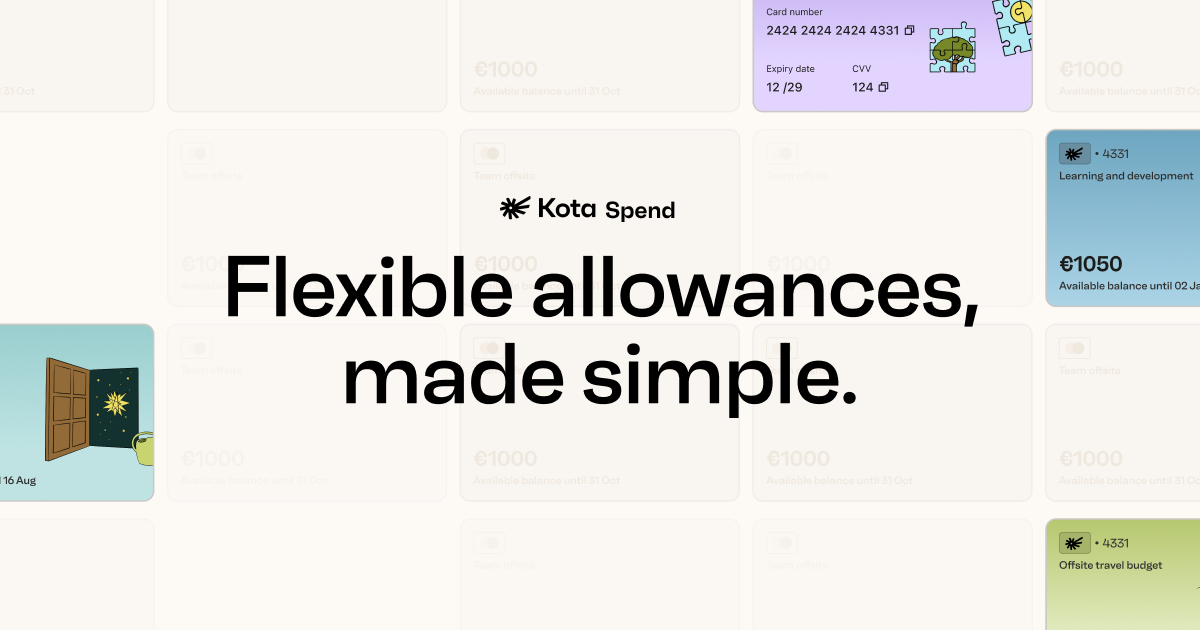
We just relaunched spend cards inside Kota - and for the first time a company can run health, pension, life cover, flex benefits and spend cards from a single platform. Spend cards were the last benefit most HR and Finance teams still managed through a separate vendor. As of today, they are not separate any more.
I want to explain why we built this, what actually changed in this release, and why it is harder to copy than it looks.
Spend cards have been in beta at Kota for a while, in the hands of a few customers and our own team. They worked well for online purchases, but they hit friction in the real world, and Finance could see card-level activity without ever getting the full picture in one place. This relaunch closes those gaps and brings the cards properly inside the platform.
Here is what we shipped:
This isn't the first employee benefits card out there. What matters is that they sit inside the same platform as the rest of a company's benefits - which is the whole point of what we've been building at Kota.
For years, HR teams have run health with a broker, pension through a portal, flex benefits on a benefits platform, and spend cards through a separate business card vendor. That is four systems for the one job of looking after your people, and every one of them is a separate login, a separate export, and a separate thing to keep in sync when someone joins or leaves.
When every benefit lives in one place, that work collapses into a single HRIS sync. A joiner switches on across health, pension, flex and cards at once, and a leaver switches off the same way. Employees get one place for every benefit instead of an app for each one. The administrative overhead that makes benefits painful is mostly the overhead of managing them in pieces, and consolidation is what removes it.
No, and this is the most common thing people get wrong about it. A Kota spend card is benefit-adjacent, not a corporate card, and we deliberately did not build it to replace one.
The point of it is to let you offer things to employees you would not otherwise have set up, because standing up a new vendor for each one was never worth it. Gym memberships, lunch allowances, wellness stipends and learning budgets all become a card you switch on, rather than a procurement project. That is a different job from the corporate card in your finance stack, and comparing the two misses what it is for.
The honest answer is that almost nobody else is positioned to do it. Running core benefits like health insurance properly needs a brokerage licence, and the companies that hold one tend not to have built the software. The companies with good software tend not to hold the licence. Kota has both, which is why we can put health, pension, life cover, flex and spend cards behind one admin surface rather than bolting a card product onto a benefits tool or a benefits tool onto a card product.
I am not saying that to claim we have it all figured out, because we do not. I am saying it because it is the reason this particular thing is defensible, and will take us further than the incumbent solutions on the market.
The version I am most excited about is the one that is still ahead of us. You open the spend tab and it is blank, and in front of you is a menu of programmes you can issue: gym cards, lunch allowances, learning budgets, wellness stipends. One click and gym benefit cards are live for every employee in the company. No vendor, no contract, no setup project, just a benefit switched on.
We are on a journey to bring every benefit into one fully automated platform that is effortless for People and Finance teams and engaging for the employees who use it. Spend cards were the missing piece, and bringing them in is a real step toward that. We are not close to finished, but this is a good day.
Luke Mackey is the co-founder and CEO of Kota. Previously, Luke was General Manager for Bolt Ireland, where he discovered the complexities of offering benefits to employees.

.png)
.png)
.svg)
.svg)
.svg)