A plain-English employer's guide to salary sacrifice in the UK. Covers how it works, tax savings with worked examples, scheme types, the April 2029 NIC changes, and how to set one up.


.png)
.png)
.png)
Most UK employers have heard of salary sacrifice. A surprising number still don't use it, though.
HMRC's policy paper on the April 2029 reform puts the figure at 7.7 million employees sacrificing salary into a pension alone. That's before you count EV schemes, cycle to work, or nurseries.
The savings add up fast. Take a 120-person SaaS company with an average salary of £55,000, where 80% of staff sacrifice 5% into their pension. That's £264,000 sacrificed across the team and roughly £39,600 a year back in employer NICs. Employees keep more of their pay too, because the sacrifice happens before tax and NI are calculated.
Whether you're setting one up from scratch or reviewing a scheme before the April 2029 changes, this is where to start.
Kota is an FCA-regulated benefits platform that manages salary sacrifice schemes for UK employers. We handle pension, EV, cycle to work, and nursery schemes in one place, with the sacrifice calculated from the HRIS record and synced to payroll and the provider each month.

Cloudsmith, a software company with 50 to 100 employees, runs its benefits through Kota. Their Chief of Staff, Lauren Seawright, said "Kota just makes everything easy." Because Kota is both the broker and the platform, what follows comes from running these schemes month to month rather than describing them from the outside.
Salary sacrifice is an agreement to reduce an employee's contractual gross pay. In return, the employer provides a non-cash benefit, like an employer pension contribution or an EV lease.
Because the employee's gross pay drops, income tax and NI are calculated on the lower figure. The employee doesn't "deduct" anything after tax. Their agreed salary is simply lower, and the benefit is provided in place of that pay.
For the arrangement to work for tax purposes, there must be a genuine change to the employment contract. HMRC's guidance on salary sacrifice is clear on this.
The employee gives up their right to part of their cash pay, and the employer provides the benefit instead. Both sides consent, and the terms get documented.
The reduction has to be a genuine change to the contract, not something the employee can switch on and off at will. If it isn't, HMRC can treat the full original salary as earnings, with tax and NICs due on all of it.
Post-sacrifice cash pay can't fall below the National Minimum Wage. For workers aged 21 and over, that's £12.71/hour from April 2026.
It's the employer's job to monitor this. If someone's hours change, their pay changes, or the NMW rate goes up, you'll need to re-check. HMRC's internal guidance spells this out. Step 4 below covers how to build that check into your monthly process rather than treating it as an annual job.
The best way to see the saving is to compare a payslip before and after. Here are the 2026/27 figures for an employee earning £35,000 who sacrifices 5% (£1,750) into a pension.
The employee is £490 a year better off in total. They take home less cash, but the pension contribution wasn't taxed and NI wasn't charged on it. Only the NI part, £140, is unique to salary sacrifice. The £350 of income tax relief would apply to any pension contribution. The employer also saves £262.50 in employer NI at 15%. Figures use HMRC's 2026/27 rates and thresholds.
For a higher-rate taxpayer on £55,000, the income tax saving doubles because they're paying 40% on that slice. The NI saving is much smaller, though, because employee NI drops to 2% on earnings above £50,270.
Every pound an employee sacrifices is a pound you don't pay 15% Class 1 NICs on. For the £35,000 employee giving up £1,750, that's £262.50 saved per year. Here's how that scales when everyone is on the same salary and contribution.
Some employers redirect part of this saving into employees' pension pots. That's optional, but it makes the scheme more attractive when you're communicating the change.
For most employers, and for employees paying basic-rate tax or above, the numbers usually stack up. Both sides save on NI, and pension contributions stretch further from gross pay.
Who benefits most:
Who should think carefully:
Not every benefit works the same way under salary sacrifice. Some are fully exempt from benefit-in-kind (BiK) tax. Others still trigger a BiK charge, so the saving is smaller.
Pension is by far the most widely used scheme. The employee's gross pay drops, and the employer pays the equivalent into the pension scheme as an employer contribution. It's completely exempt from income tax and NICs.
The employer saves too, because Class 1 NICs don't apply to the sacrificed amount, which is why 7.7 million UK employees currently use it.
Zero-emission cars have a BiK rate of 4% for 2026/27, rising to 5% in 2027/28. An employee leasing a £40,000 EV through salary sacrifice pays BiK tax on £1,600 of notional value. For a basic-rate taxpayer, that's £320 a year, still far below the income tax and NI saved on the lease payments.
Under cycle to work, the employer buys or leases a bike and safety equipment, and the employee sacrifices salary to cover the cost. It's fully exempt from BiK during the hire period. The old £1,000 cap no longer applies to schemes run through an FCA-authorised provider, and the main thing to get right is the end-of-hire ownership transfer. If the employee buys the bike for less than HMRC's market value table, 25% of the original price after one year for bikes over £500 and 18% for cheaper ones, the difference is a taxable benefit. Extending the hire agreement instead avoids the charge.
Salary sacrifice for tech, gym memberships, or other non-exempt benefits still saves on NI. But HMRC treats the benefit as a taxable BiK, so the saving is smaller than for exempt schemes.
There's no statutory cap. The practical limits come from two places.
First, the National Minimum Wage floor covered above. That's the legal limit and it applies to every scheme.
Second, for pensions, the annual allowance sets a ceiling. It's £60,000 for 2026/27, and contributions above that attract a tax charge. The allowance tapers to £10,000 for adjusted income above £260,000. Employees can carry forward unused allowance from the previous three years if they were pension scheme members, per HMRC.
Beyond those limits, it's a personal decision for each employee. Employers set out the options and the maths, and leave the amount to the individual.
Salary sacrifice is a net positive for most employees, but there are situations where it reduces entitlements. You'll want to explain these before anyone opts in.
SMP, paternity pay, SSP, and adoption pay are all based on post-sacrifice earnings. If average weekly earnings drop below £123/week (the lower earnings limit for 2026/27), the employee loses entitlement entirely.
NI contributions are calculated on lower earnings too, so contribution-based state benefits could shrink over time. For most employees sacrificing a modest percentage, that won't matter. But for lower-paid staff, it's worth flagging before they sign up.
A common worry is that the lower payslip figure hurts mortgage affordability. An employee on £35,000 who sacrifices £1,750 will show £33,250, but most lenders assess on the pre-sacrifice salary once the employer confirms it.
A letter confirming the original salary and the sacrifice usually covers it, so employees planning a mortgage should ask for one before they apply.
Salary sacrifice adds a moving figure to every payslip. It changes with pay rises, hours, joiners, and leavers, and each change has to reach the HRIS, payroll, and the provider. Done by hand, that's a monthly reconciliation job, and the errors show up as incorrect deductions that finance then has to reverse. Budget for the admin as well as the NIC saving, or automate it. Step 3 covers what that looks like in practice.
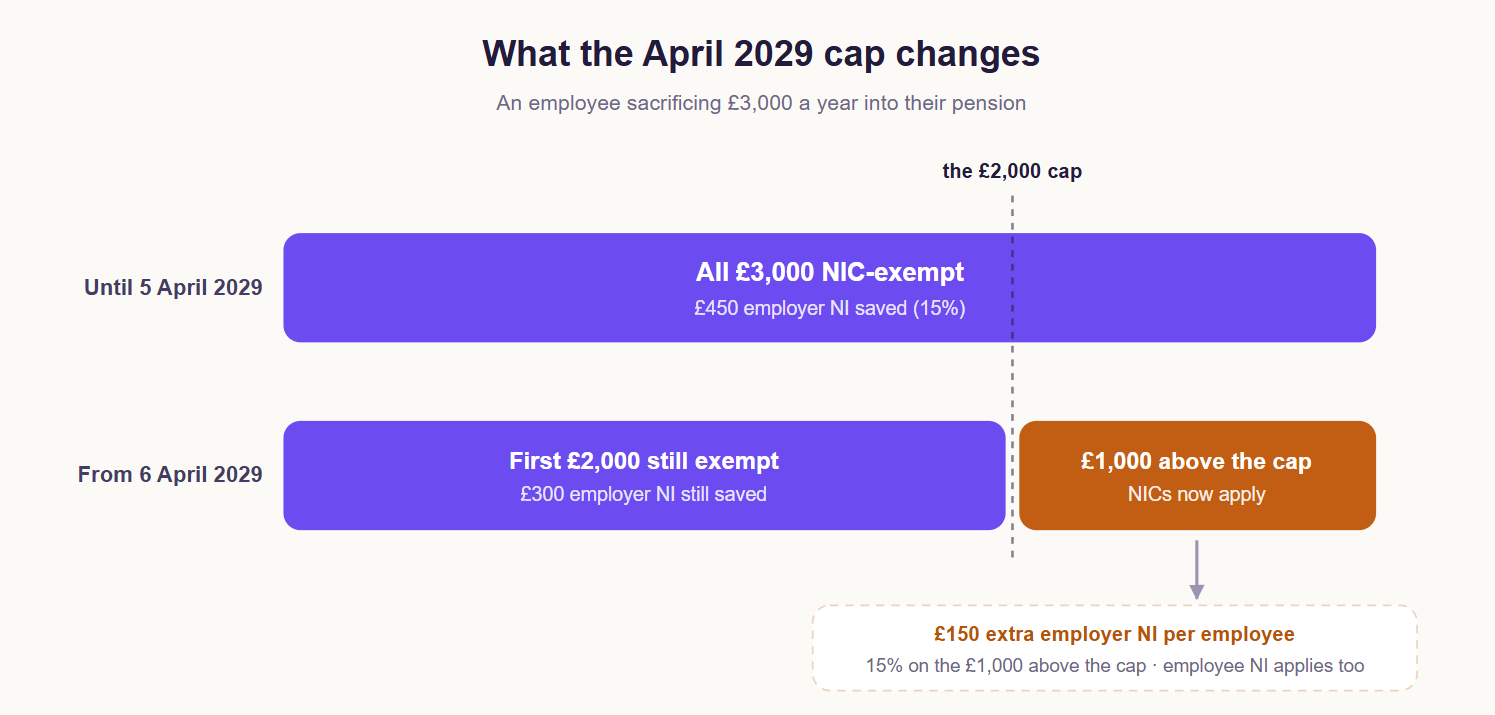
Under current plans, from 6 April 2029 the government will cap the NIC exemption for pension salary sacrifice at £2,000 per employee per year. Anything above that threshold will be subject to employer and employee NICs.
What changes:
What stays the same:
What to do now:
Model the extra NIC cost at your current contribution levels so you aren't caught off guard. For a 100-person company averaging £3,000/employee in pension sacrifice, the extra employer NIC on the £1,000 above the cap would be £15,000/year. For the 120-person SaaS company from the intro, on £2,750 per head, it's £10,800.
Review your auto-enrolment pension setup too, so you know exactly how contributions are structured today and can brief employees on what changes for them from April 2029.
Decide which schemes you'll offer. Pension is the most common starting point. You might also look at EVs, cycle to work, or nurseries, depending on what your employees want.
Model the NIC savings for your workforce using your headcount, salary spread, and likely uptake. Even 50% uptake on pension sacrifice usually shows a saving that justifies the setup cost.
This is what HMRC scrutinises most closely. A valid salary sacrifice needs a genuine contract variation for each employee who opts in. The terms must show the reduced salary and the benefit provided instead.
Decide what happens to the reference salary at the same time. That's the pre-sacrifice figure used for pay rises, bonuses, overtime, life cover, and redundancy pay. Most employers keep those calculations on the notional pre-sacrifice salary and write that into the variation, so nobody loses out on a pay review or a death-in-service payout because they joined the scheme.
Salary sacrifice also has to sit alongside auto-enrolment, not replace it. You can't make joining the sacrifice arrangement a condition of pension membership, and anyone who declines still has to be enrolled with contributions taken the standard way. Keep a non-sacrifice route open and document it.
You'll also need to communicate the change clearly. Every employee should understand what they're giving up, including the impact on statutory payments and what to tell a mortgage lender.
Salary sacrifice contributions should show as employer contributions, not employee deductions from net pay. Get that wrong and you'll lose the NIC saving entirely.
Confirm with your pension provider that they can accept contributions on this basis. Most modern providers can.
What actually breaks each month
A sacrifice amount is usually a percentage of a salary that keeps moving. Every pay rise, promotion, change of hours, or period of unpaid leave changes the figure. It then has to change in the HRIS, in payroll, and at the pension provider, all in the same pay run.
Joiners and leavers are where it goes wrong most often. A new starter set up in HiBob or Personio but not yet at the provider gets the wrong deduction in month one. A leaver removed from payroll but still lives at the provider keeps generating contributions until someone spots it. Both end in a payroll correction, and usually a manual one.
The underlying problem is three systems holding three versions of the same number. Payroll knows the salary, the HRIS knows the contract change, and the provider knows the contribution. Keeping them in agreement is nobody's job in particular, so it falls to whoever runs payroll that month.
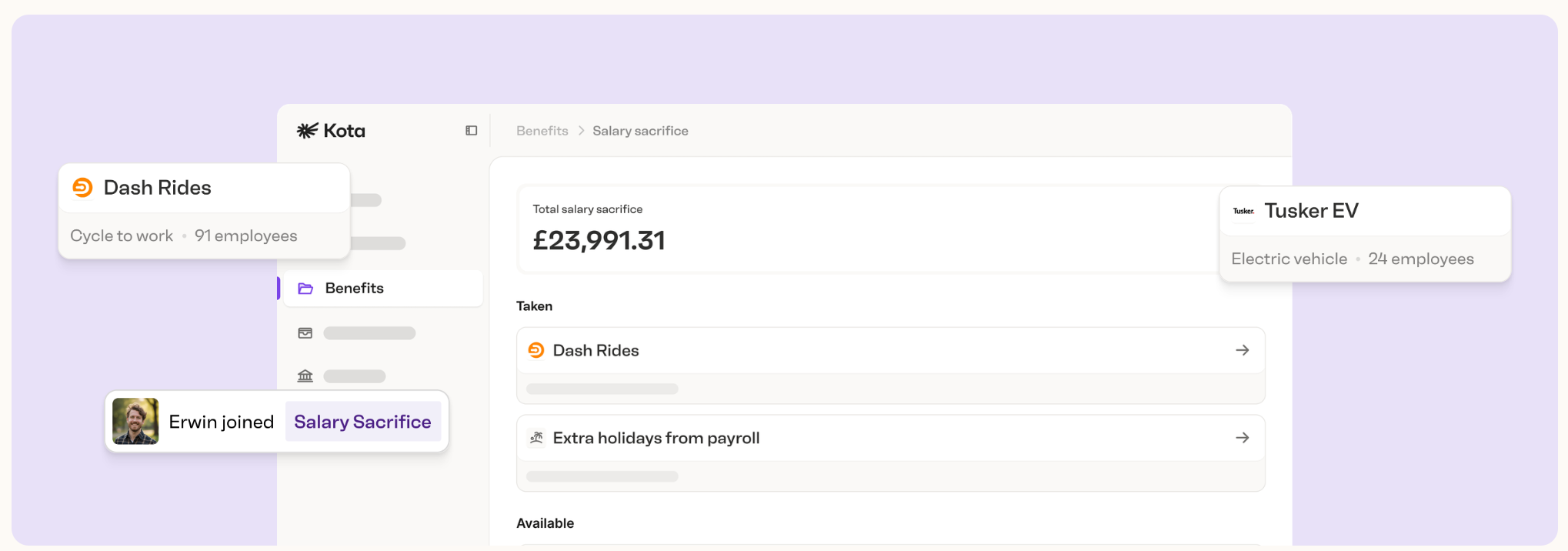
Kota's platform takes the salary from your HRIS record, calculates the sacrifice, and pushes the same figure to payroll and the provider. One number in three places, updated automatically when the salary changes, instead of three numbers someone reconciles by hand.
HMRC expects you to hold evidence of the arrangement. That means the varied contract, the employee's agreement, and before-and-after payslips.
The minimum wage check is ongoing, not a one-off. The triggers are the same ones that move the sacrifice amount in Step 3, so it makes sense to run both in one process. If the sacrifice is recalculated from the HRIS record automatically, the NMW check runs on every change as part of the same benefits administration workflow, rather than sitting in a spreadsheet someone remembers to update each April.
It depends on the terms. Most arrangements include "life event" triggers for opting out, like getting married, having a baby, or redundancy. Outside those, it's fixed for a set period, usually 12 months.
The arrangement ends when employment ends. For pensions, contributions stop and the pot stays with the provider. For EV or cycle to work schemes, the agreement's leaver terms cover what happens to the lease or equipment. Make sure the leaver is removed at the provider in the same pay run they leave payroll, or contributions carry on.
Yes. A higher-rate taxpayer saves 40% income tax plus 2% NI on every pound above the higher-rate threshold. A basic-rate taxpayer saves 20% plus 8%. The employer's NIC saving doesn't change between tax bands, because it's a flat 15% above the secondary threshold.
Salary sacrifice is straightforward in principle. But the monthly admin piles up. Sacrifice amounts shift with every pay rise, leavers stay live at the provider, NMW needs re-checking, and three systems never quite agree. Add a second or third scheme and it multiplies.
Kota brings it all into one platform with provider reconciliation built in. If you're setting up for the first time or reviewing ahead of April 2029, book a demo to see how it works.
Senior benefits consultant at Kota, bringing 25+ years of experience working in employee insurance benefits.

.png)
.png)
.svg)
.svg)
.svg)