
Free tools
Salary Sacrifice Calculator for UK Employers
Model how much your business saves in employer National Insurance when staff sacrifice salary into a pension, cycle to work, or another qualifying benefit. Switch to employee view to show any individual their take-home pay before and after.

How to use
the calculator
Employer view
Enter your headcount, average salary, the share of staff you expect to take part, and the sacrifice percentage. You'll see the annual employer NI saving, the saving per participating employee, and how the figure changes once the April 2029 cap applies.
Employee view

Enter one salary and a sacrifice amount to see take-home pay, Income Tax, and NI before and after, alongside the amount going into the benefit. Useful for answering the "what does this mean for me" question when you roll the scheme out.

All figures are illustrative estimates based on what you enter and 2026/27 HMRC rates. They aren't recommendations and shouldn't be treated as financial advice. For the full picture on how schemes work and what to check before launching one, read the salary sacrifice guide for employers.
What the numbers mean for your business
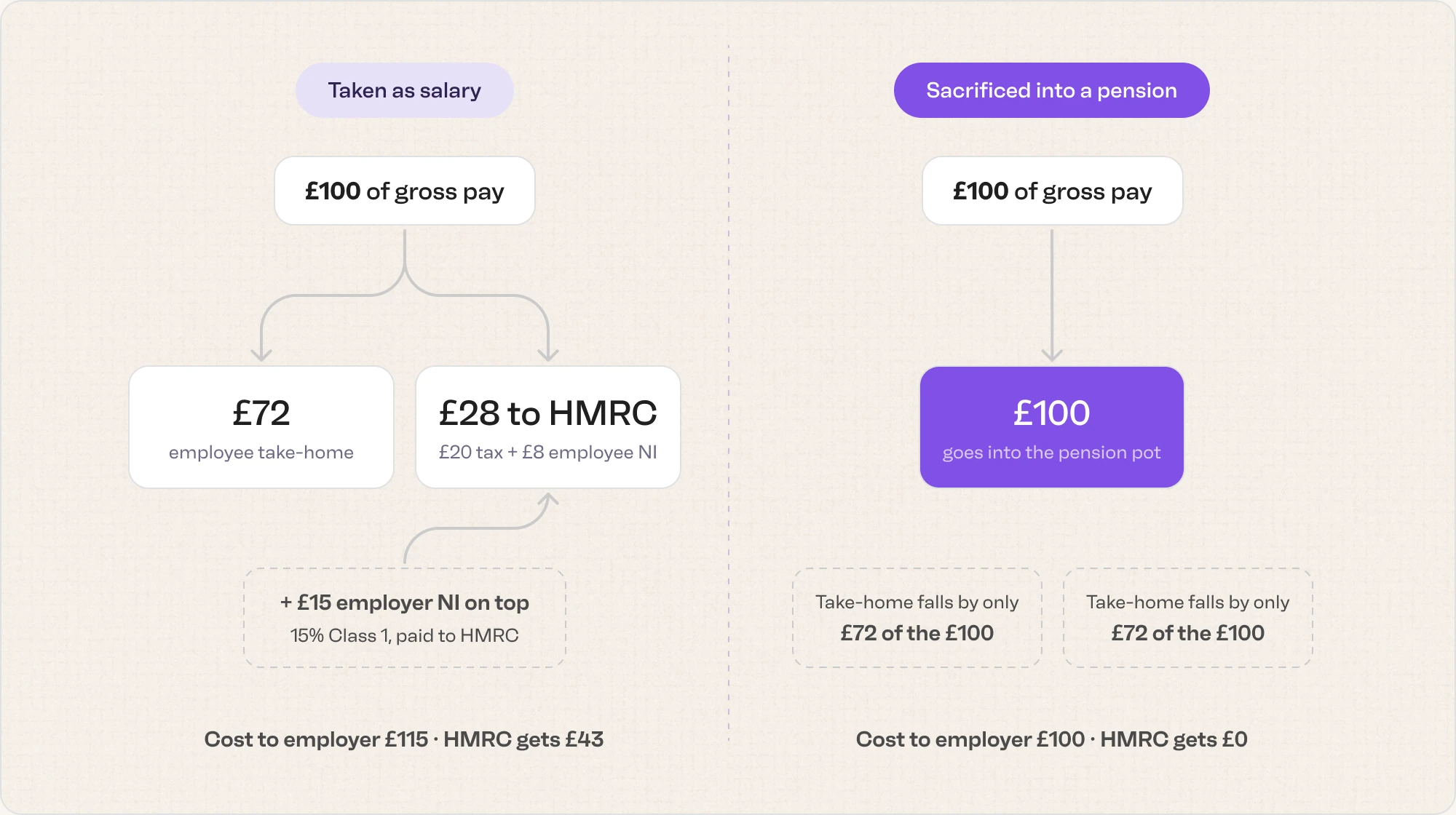
Every pound an employee sacrifices is a pound you don't pay 15% Class 1 employer NI on.
One employee
£262.50
An employee on £35,000 sacrificing 5% saves you £262.50 a year.
100 employees
£26,250
Across 100 participating employees on the same terms, that's £26,250.
120-person SaaS team
£39,600
Across a 120-person SaaS team on an average £55,000 with 80% take-up, it's roughly £39,600.
Employees save too. The sacrificed amount isn't subject to Income Tax or employee NI, so a basic-rate taxpayer keeps 20% tax plus 8% NI on every pound, and a higher-rate taxpayer keeps 40% tax plus 2% NI.
Basic-rate taxpayer
20% tax + 8% NI
Higher-rate taxpayer
40% tax + 2% NI
Which benefitsare fully exempt?

Pensions and cycle to work
Pensions and cycle to work are fully exempt from Income Tax and NI.

EVs, nurseries, tech
EVs, workplace nurseries, and tech are treated differently, and the calculator applies the right rule for each.
From 6 April 2029
The April 2029 cap
From 6 April 2029, the employer and employee NI exemption on pension salary sacrifice is capped at £2,000 per employee per year. Anything above that is charged as normal. A 5% sacrifice crosses £2,000 at a £40,000 salary, so for most tech and professional payrolls the cap affects the majority of staff.
The employer view shows your savings before and after the cap so you can see what changes and plan contribution levels ahead of time. Non-pension schemes aren't affected.

Before you roll it out

Ongoing admin
The sacrifice figure changes with every pay rise, joiner, and leaver, and has to match across your HRIS, payroll, and provider each month. Kota handles salary sacrifice from the HRIS record outward, alongside pension auto-enrolment, P11D reporting, and benefits-in-kind calculations, so there's no spreadsheet to maintain.
Statutory payments
Maternity, paternity, and sick pay are calculated on post-sacrifice earnings, and anyone whose average pay falls below the lower earnings limit (£129 a week in 2026/27) loses entitlement altogether.
Statutory maternity pay itself can't be sacrificed and must be paid in full, and non-pay contractual benefits continue through maternity leave.
Reference salary
Decide whether pay rises, bonuses, and life cover are based on the pre- or post-sacrifice salary, and write it into the contract variation.
NI thresholds
Employee NI is 8% on pay between £12,570 and £50,270 and 2% above that, so an employee's own saving is smaller on earnings over £50,270. Employer NI is 15% on everything above £5,000 with no ceiling.

Minimum wage floor
Post-sacrifice pay can't fall below the National Minimum Wage (£12.71/hour for 21 and over from April 2026).
Frequently asked questions
.svg)
15% of every pound sacrificed, which is the Class 1 employer NI rate for 2026/27. The saving scales directly with headcount and participation, so the calculator's employer view is the quickest way to get a figure for your business.
There's no HMRC charge. The cost is the contract variations, the payroll change, and the ongoing admin. Some employers put part of the NI saving back into employee pensions to make the scheme more attractive.
Pension salary sacrifice above £2,000 per employee per year becomes subject to NI. The first £2,000 stays exempt, Income Tax relief is unchanged, and non-pension schemes aren't affected. The calculator shows both the current and post-2029 figures.
Workplace pensions, cycle to work, electric vehicle leasing, workplace nurseries, and some tech schemes. Pensions, cycle to work, and directly contracted nurseries are exempt from Income Tax and NI. EVs carry a low benefit-in-kind charge (4% in 2026/27) and tech is fully taxable as a benefit in kind, so the saving there is NI only.
Gross pay goes down, but less tax and NI is paid on the sacrificed amount, so take-home usually drops by less than the full sacrifice. The employee view shows the exact figures for any salary.
It can. Lenders usually assess affordability on the payslip salary, and a sacrifice lowers that figure. Some accept the pre-sacrifice salary with a letter from the employer, so it's worth mentioning when staff opt in.
There's no fixed cap. Pay can't fall below the National Minimum Wage, and for pensions the annual allowance (£60,000 in 2026/27) still applies. Beyond that, the amount is the employee's decision within your scheme rules.
Run every salary sacrifice scheme from one place
Kota brings pension, cycle to work, EVs, and flexible spend into one platform with built-in compliance and automatic sync to payroll and providers.
.png)
Benefits you and your employees will love using
.svg)
.svg)
.svg)


