
Free tools
Free Offer Letter Generator
Build an offer letter that shows a candidate the whole package rather than the salary line on its own. Add your logo and brand colour, enter the base salary and the benefits, and you get a branded letter with the total compensation figure, a breakdown of what makes it up, and monthly and annual numbers. It's free, there's no account to create, and you can send it as a PDF or a shareable link.
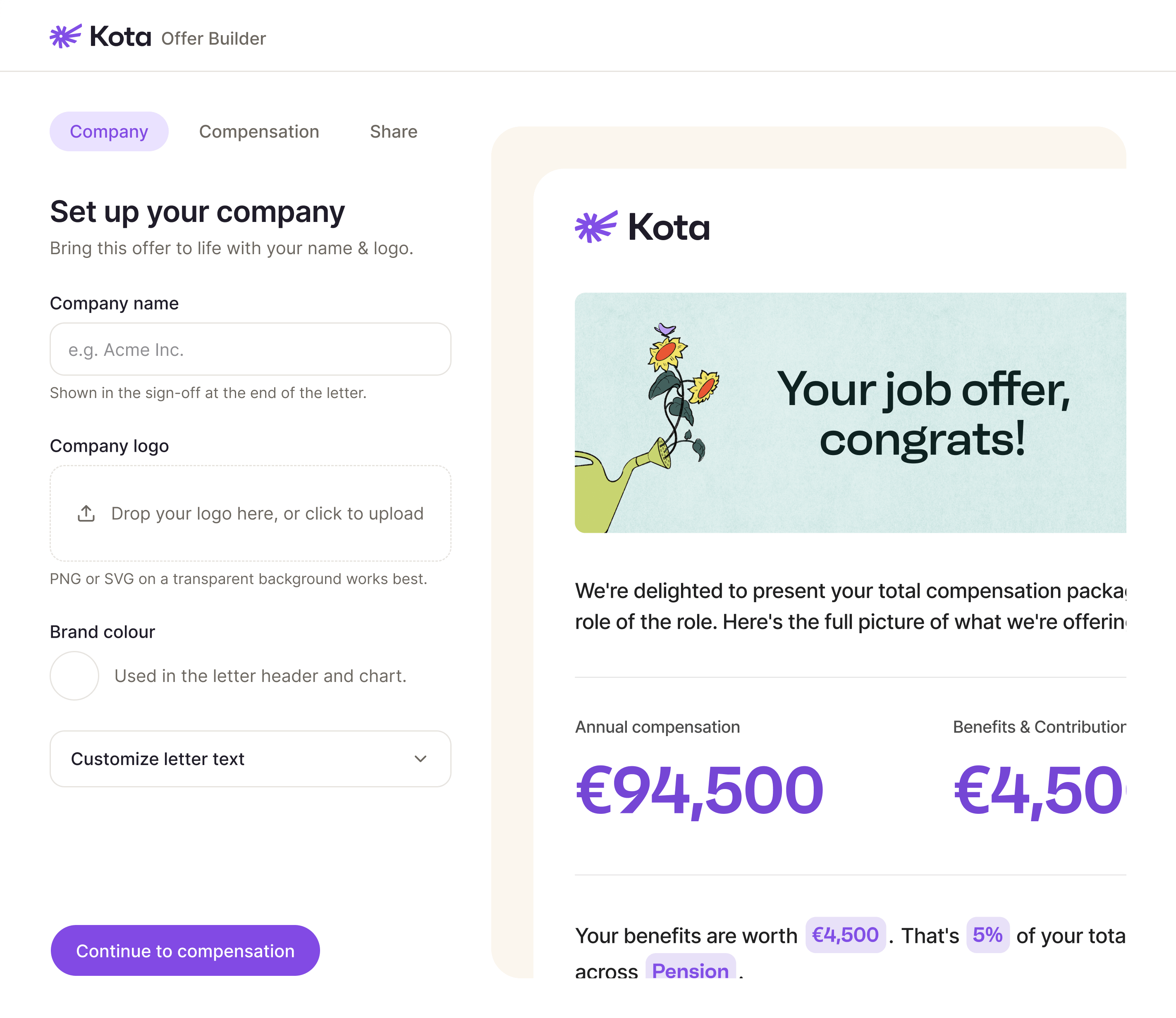
How to use the offer letter generator

Set up your company
Company name, logo (a PNG or SVG on a transparent background works best), and a brand colour, used in the letter header and the chart. The letter text and the sign-off are editable if the default wording isn't yours.

Build the package
Candidate name, role, country, currency and base salary. Then the benefits that carry a number: pension, insurance, equity, L&D, allowances and anything custom you want to price. Figures update as you type.

Share it
Save as a PDF, or create a link to paste into your offer email. You can add a banner image and a video introduction of up to sixty seconds, which shows as a circle on the letter.

Figures in the letter are annual estimates shown for illustration. The letter isn't a contract of employment, and it doesn't replace the written terms you have to give a new starter.
Why total compensation belongs in the offer
Most offer letters state a salary and list the benefits as words. That understates the offer and makes it harder to compare against a competing one, because the candidate is weighing two numbers and only one of them is complete.
the salary line
£55,000
£55,000 offer with a 5% employer pension contribution
£57,750
Add the health insurance premium you pay, a learning budget and a home-office allowance and the difference between the salary line and the value of the role runs into thousands.

Health insurance

Learning budget

Home-office allowance
You have already committed to that spend. Putting it on the page is what makes the candidate aware of it.

In the offer
The candidate is weighing two numbers and only one of them is complete

In a counter-offer
The same applies when you're trying to keep someone. If a counter-offer arrives with a higher base, an employee who has never seen their benefits priced has no way to weigh it properly.
What to include
Include anything with a number you'd stand behind: employer pension contribution, the premium you pay for health cover, the cash value of an L&D or wellness budget, an equity grant. Leave out anything you'd have to guess at. Culture and flexibility are worth talking about, but they don't belong in a compensation table, and a padded total does more damage than a modest one because the candidate will check it.
Two figures need care. Equity is a projection rather than cash, so show the grant instead of folding a valuation into the headline total. And where a benefit runs through salary sacrifice, the cost to you and the value to the employee are different numbers. The salary sacrifice calculator shows both sides.

Before you send it

The offer letter isn't the written statement
In the UK, employees and workers must get a written statement of employment particulars, and the principal statement is due on or before the first day of employment. In Ireland, the core terms are due within five days of starting and the remaining terms within a month. An offer letter and a total compensation summary sit alongside those documents rather than replacing them.
Make the offer conditional, in writing
State references, right to work, and any DBS or Garda vetting as conditions in the letter. In the UK a right to work check has to be completed before employment starts for you to have a statutory excuse.
Say which figures are estimates
Premiums change at renewal, pension percentages depend on scheme rules, and equity depends on a valuation. The generator's default disclaimer covers this, so keep it if you edit the letter text.
Keep the benefits figures accurate after day one
The numbers in an offer letter hold only while the package behind them is in sync. Kota reads joiners, leavers and salary changes from your HRIS and pushes them to providers and payroll, so a new starter gets the pension percentage and the cover they were promised.
Check what you have to disclose and what you can't ask
Pay transparency rules in Ireland, following the EU Pay Transparency Directive, move towards publishing a salary or range before interview and away from asking candidates about their pay history. Confirm the current position before you rewrite your job ads.
Frequently asked questions
.svg)
Usually not on its own. An offer letter sets out the headline terms and is normally made conditional. The contract forms when the candidate accepts, and the statutory written terms follow on or before day one in the UK and within five days in Ireland. The letter this tool produces states that its figures are estimates and don't form a contract.
Role title, start date, base salary and pay frequency, place of work, hours, notice period, probation, holiday entitlement, benefits, and the conditions the offer depends on, such as references, right to work and any vetting. A total compensation summary isn't required, but it's the part candidates respond to.
It's free and there's no sign-up. You can build a letter, save it as a PDF and share a link without creating anything.
Ireland, the United Kingdom, Germany, France, the Netherlands, Spain, Portugal, Italy and the United States, each with the right currency. The benefit figures are your own, so it works anywhere your package is priced in one of those currencies.
Start with what you pay: employer pension contribution as a percentage of the base, the annual premium you cover for health and dental, the multiple on life assurance, and the cash value of any allowance or budget. The benefits benchmarking tool compares your package against employers of your size and industry if you also want to know how it looks against the market.
No. It builds one letter at a time and doesn't track candidates, approvals or e-signature. It produces the document and leaves the pipeline where it is.
Yes. The letter text and the sign-off are editable, and you can add a banner image and a short video introduction. Keep the estimates disclaimer if you rewrite it.
In Ireland that's the direction of travel under the EU Pay Transparency Directive, which points employers towards disclosing a salary or range in the advert or before interview. The UK has no equivalent statutory requirement. Publishing a range and then showing total compensation at offer stage is consistent either way.
Run the benefits behind the offer from one place
Kota brings pension, health insurance, life assurance and flexible spend into one platform, with the broker built in and automatic sync to payroll and providers.
Benefits you and your employees will love using
.svg)
.svg)
.svg)


