
Free tools
Employee Benefits Benchmarking for UK and Irish Employers
See how your benefits package compares against employers of your size, in your industry, in your market. Enter your company profile and what you currently offer to get a percentile ranking for the package overall, plus a benefit-by-benefit comparison on pension, health insurance, life cover and income protection.
How to use the benchmark

Company profile
Choose your region — Ireland or the UK — plus your industry and headcount. Percentiles compare you against employers that match you, so a 40-person tech firm isn't measured against a 2,000-person bank.

Your current benefits
Toggle on what you offer today, then add the detail: health insurance spend and dependant cover, pension percentages, group life multiple, income protection, dental, wellness and anything custom.

Your report
Enter your work email to get your overall percentile, a benefit-by-benefit comparison against the market, and recommendations on what to change first. Most employers finish in under two minutes.

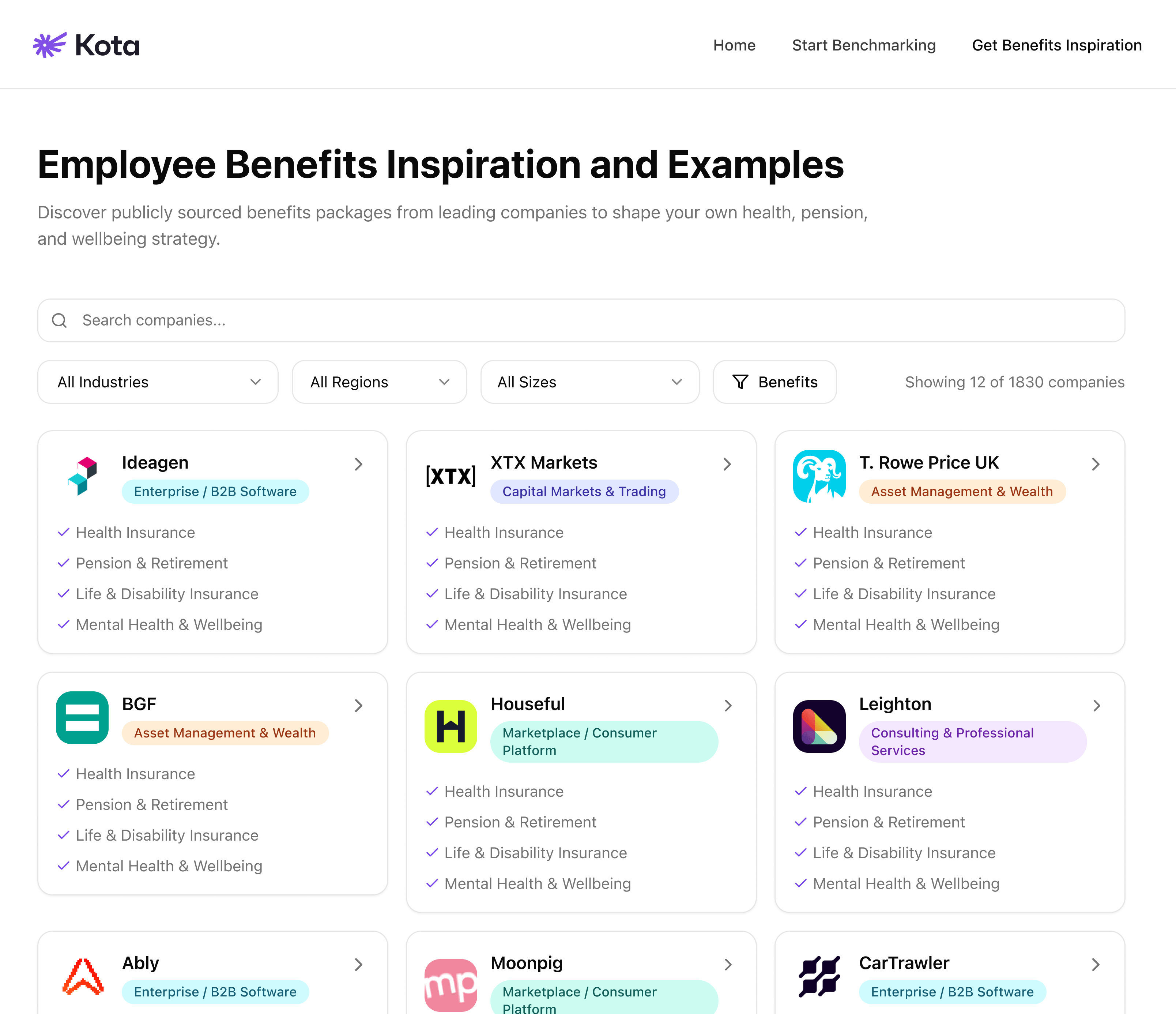
The benchmark is free and there's no call attached to it. Figures come from packages employers have published, so the output is a read on the market rather than an actuarial valuation. The benefits inspiration library shows what named companies offer if you want ideas before you start.
What a percentile tells you
A 60th-percentile package means 60% of comparable employers offer less than you do and 40% offer more. It measures how competitive your package is, not how well designed it is. What it answers is whether a candidate holding your offer and a competitor's will see something better, worse or the same.
UK auto-enrolment, employer minimum
3%
Ireland, My Future Fund employer rate from January 2026
1.5%
A package can sit at the 75th percentile on spend and still rank badly on the benefits employees use most. A generous pension alongside no income protection is a common shape, and it reads differently to a candidate than the percentile suggests.

Income protection

Dental

Dependant cover on health
Both markets have a statutory pension minimum, and both are easy to mistake for a competitive position.
In the UK
Auto-enrolment requires a total minimum contribution of 8% on qualifying earnings between £6,240 and £50,270, of which the employer must pay at least 3%.
In Ireland
My Future Fund began taking contributions in January 2026 at 1.5% from the employer, 1.5% from the employee and 0.5% from the State, rising in steps to 6%, 6% and 2% over ten years. It applies to employees aged 23 to 60 earning €20,000 or more who aren't already in a scheme.
Why the auto-enrolment minimum isn't a benchmark
Meeting the minimum puts you at the bottom of the distribution rather than the middle. The benchmark shows the gap between the legal minimum and the market so you can decide which one you're aiming at, and the pension input flags where you sit against the Irish exemption rules.
Statutory detail: in the UK the employer must pay at least 3% of qualifying earnings, and in Ireland My Future Fund phases from 1.5% to 6% over ten years.

Before you change your package

Benchmark the whole package, not one benefit
Moving your pension contribution up a point is the easiest change to make and rarely the one that shifts your ranking most. Adding cover employees don't have at all, such as income protection, dental or dependant cover on health, usually moves the percentile further per pound.
Check what's actually used
Utilisation tells you whether a benefit earns its cost, and it's the number that gives you leverage at renewal. Kota's benefits team benchmarks and renegotiates year-round rather than in the two weeks before the notice lands. See how pricing works.
Time it against your renewal
Adding cover mid-term usually means a separate policy and a second renewal date to manage. The benchmark asks for your health insurance renewal month for this reason. Changes are cheapest to make when the policy is already open.
Decide what you'll tell employees
A package employees can't see won't help you keep them. Every Kota employee gets an app showing exactly what they're covered for, along with a total reward statement.
Price the admin as well as the premium
Kota runs health insurance, pension, life assurance and flexible benefits from one system wired into both, so the admin doesn't grow with each benefit you add.
Frequently asked questions
.svg)
Comparing your benefits package against what comparable employers offer, in the same market, industry and rough headcount, so you can see whether it's competitive instead of guessing. It answers a narrow question: would a candidate choosing between you and a peer see a better package elsewhere?
Yes. You give a work email to receive the report. There's no charge and no obligation to speak to anyone.
Benefits packages published by employers across the UK and Ireland. It's the same dataset behind the benefits inspiration library, which currently covers 1,830 companies. The packages are disclosed rather than surveyed, so the output is useful for positioning yourself and not for pricing a policy.
Health insurance (employer spend per employee per month, and whether dependants are covered), pension (employer and employee contribution percentages), group life (salary multiple), income protection (percentage of salary covered), dental, and a spend or wellness card. Anything else you offer can be added under other benefits.
Ireland and the United Kingdom.
It depends on your market and industry, which is what the benchmark is for. The floor is clearer. In the UK the employer must pay at least 3% of qualifying earnings, and in Ireland 1.5% until the My Future Fund phasing steps up. Matching the statutory minimum puts you at the bottom of the distribution.
Once a year, ahead of your main renewal, is enough for most employers. That's early enough for anything you want to change to be built into the renewal rather than bolted on afterwards. Benchmark again if your headcount changes materially or you start hiring into a new market.
Not always. Ranking depends on which benefits you offer as much as how much you spend on them, so a package with a generous pension and no income protection often ranks below a more evenly spread one costing the same. The benefit-by-benefit view shows where the cheapest ranking gains are.
Run every benefit from one place
Kota brings pension, health insurance, life assurance, income protection and flexible spend into one platform, with the broker built in and automatic sync to payroll and providers.
Benefits you and your employees will love using
.svg)
.svg)
.svg)


